
Bridgerton is Idealising a Time That Never Existed
by Alexia Suceveanu
Bridgerton is a very popular series that aired on Netflix in 2020 based on a series of books by Julia Quinn. Each series focuses on a member of the Bridgerton family navigating through the town ‘high society’ and balls searching for a life partner. Throughout the series an anonymous paper is regularly published referred to as ‘Lady Whisteldon’, the writer is only revealed in the third season, who writes about the latest gossip and scandals that took place stirring trouble throughout the seasons. The intrigue of the show comes from the glamour of the balls and the tension between characters as their secrets and lies are revealed.
The series presents itself as part of the historical romance genre with modern influence, to appeal to our current society. The series moves further from being ‘historical’ each season, in fact the costume designer clarified that the costumes are intended to be “aspiration not historically accurate”, however at what point does the show just feel too modern as if an entire society was tweaked to fit in with modern trends? The orchestra is playing Ariana Grande and Taylor Swift instead of the usual waltz pieces in its removed from reality balls.
Bridgerton has become a complete reimagination of the past, a fantasy that erases reality of what life would have actually been like in the Regency Era. The series prides itself on accessibility to a modern audience, but to what extent is this ‘accessibility’ diminishing the appeal of the series.
A large part of the mystical world created within regency and period pieces is of course the dresses. Imaging oneself in a beautiful pastel gown, that of a Bridgerton, about to attend a glamorous ball you girls now dream of and living a luxurious yet now impossible lifestyle. What keeps viewers watching Bridgeton, a series that lacks historical accuracy and could easily be summarized as four seasons of contextually unrealistic gossip.
What attracts people to a show like Bridgerton, that attempts to portray a society that Britain spent decades fighting against and evolving from? The entrapment of women by society in this series is criticised heavily by some characters most significantly, Eloise and Penelope. Throughout the seasons, the viewer sees the struggle young women like Penelope have to express their opinions and independence, all of which she is only able to achieve through anonymity when writing. Despite this the show still manages to nourish the audience's designer to be there.
Beyond the tightly pulled double and single corsets, too many strikingly inaccurate liberties were taken in the make up, acrylic nails and incredibly low necklines of the characters. The most clear separation from reality is perhaps the colour palette used in Penelope’s clothes, that of her entire family for the matter. The bright yellows, pinks and greens they displayed in the first two seasons were far enough from the reality of the period which consisted of pale and pastel colours such as those of the Bridgeton family women. Below you can see the striking colours of Penelope especially in contrast to Eloise on the right.
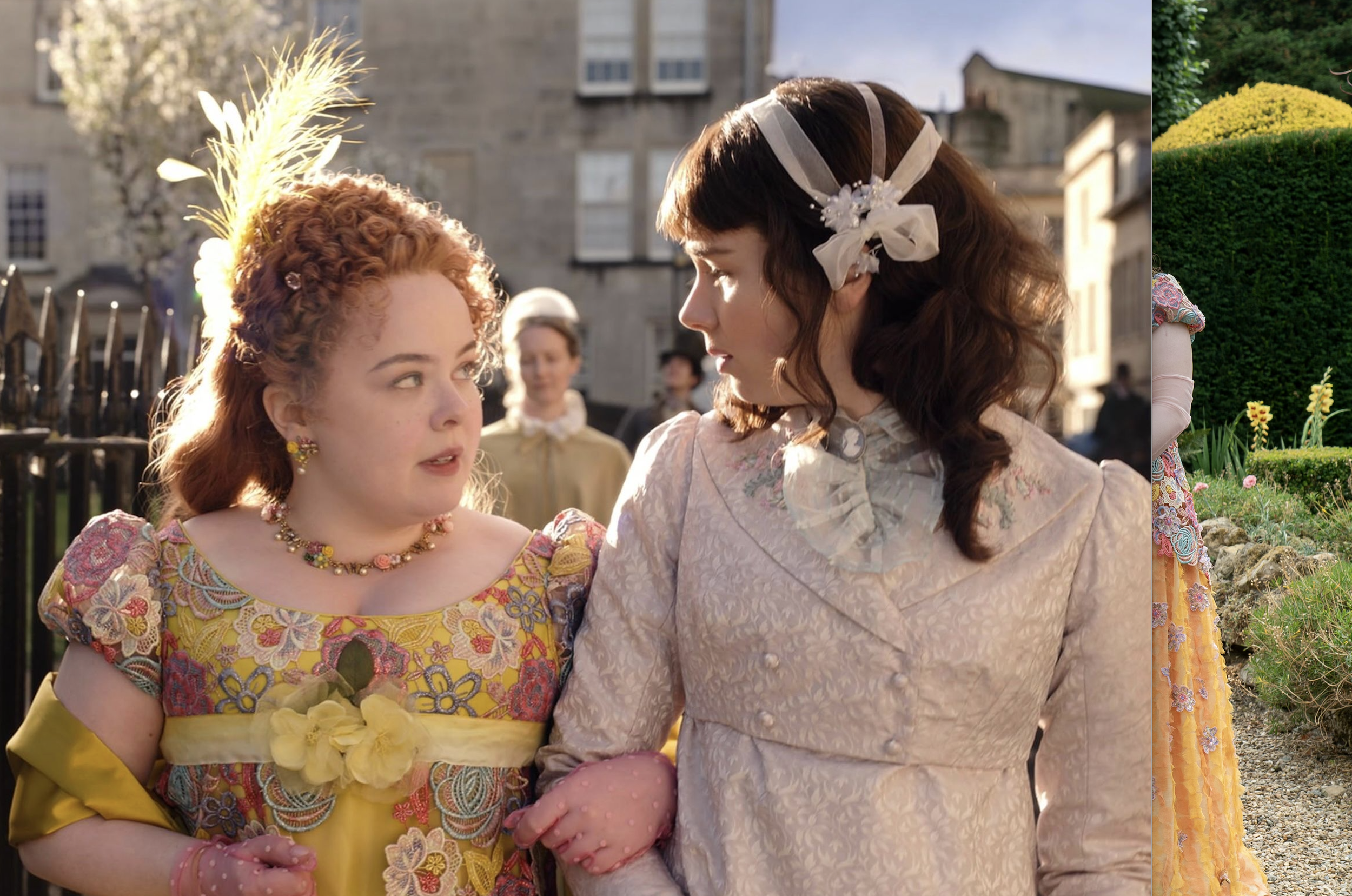
Courtesy of Netflix
Since Penepole’s ‘make over’ in the third season the costumes in the series feel like their own genre entirely. These directorial choices are defended by their symbolism of the families, personalities and intentions of characters, nonetheless they are completely unrealistic much like many of the plot twists in the most recent two seasons. The latest season itself stands out like a needle in a hay stack among period pieces as a mere adaptation of Cinderella embedded into the series. Bridgerton makes viewers wish they lived in a time that in fact never existed, it is almost entirely fictional.
The series could easily have been popular without the oversimplification of dialogue and the inaccuracy of the characters' appearances. Previous regency era adaptations of Jane Austen have been incredibly successful without losing too much of the integrity of the era including the 2020 Emma and the 1995 movie Persuasion. Focusing more on Emma, the movie stays true to the class structure at the time and manages expectations unlike the unrealistic Cinderella take in the latest season. The light and looser structure and style of the dresses is also far closer to reality. Emma is generally far more concentrated on portraying the correct etiquette through details such as gloves and speech which is far more traditional and formal.