
Yves Saint Laurent and Photography: The Muse and the Maker
by Charlotte Kaye
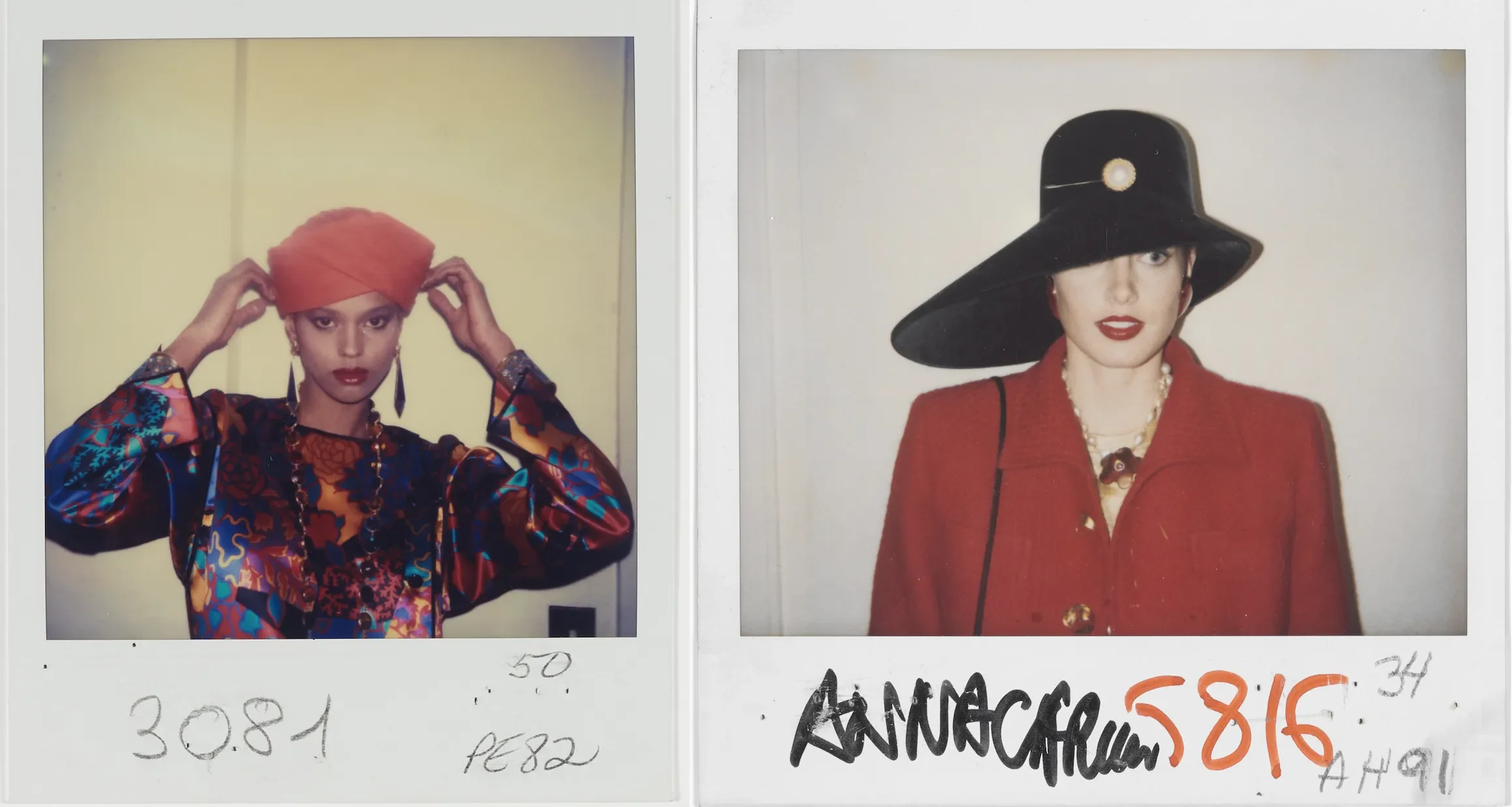
At the International Center of Photography (ICP), nearly 300 photographs trace how Yves Saint Laurent’s designs came alive through the women who wore them, and raises questions about who gets remembered as the artist?
A woman stands alone in an enormous stone room. Her face is almost completely lost to shadow. The evening gown she wears is equally difficult to see, only a flash of color escapes from her waist. Sunlight cuts across the wall behind her, but never quite reaches her. For a fashion photograph, Dominique Issermann’s image does little to sell us a dress.
This contradiction followed me through the Yves Saint Laurent and Photography exhibition. Across nearly 300 photographs and archival objects, clothes are ostensibly the subject, but women occupy almost every frame. What began as an exhibition about a designer quickly became, for me, an exhibition about the women through whom Saint Laurent’s visions became visible. They wear his ideas, perform them, giving them life.
The exhibition led me to a series of questions. When do models function as collaborators in fashion photography? When does she become a muse- something onto which an idea can be projected? And when a woman becomes the embodiment of an artist's vision, how much of her own identity is she asked to surrender?
The exhibition traces Saint Laurent’s relationship with photography across roughly four decades and includes photographers ranging from Irving Penn to Helmut Newton. The sheer number of images initially makes the exhibition feel almost overwhelming. Moving through the galleries, silhouettes shift, and photographic styles shift from Polaroids and contact sheets to editorial images, but one pattern repeats itself: again and again, the female body becomes the place where the designer’s imagination is made visible.
In Dominique Issermann’s Evening dress from Fall/Winter 1984 haute couture collection, a model stands in profile within a vast stone interior, her body reduced to a dark silhouette against the wall behind her. She wears a long black gown that nearly disappears into shadow, interrupted only by a sharp burst of red and green at the waist. Her head tilts forward, her arms draw behind her back, and her body appears both poised and withdrawn. Sunlight enters from the side, casting angular shapes across the wall and tiled floor, yet it stops just short of reaching her. The image is spare and theatrical at once, balancing the severity of the architecture against the elegance of the gown.
In an exhibition built around a designer famous for transforming women into visual icons, this photograph focuses more on evoking a mood. The model becomes difficult to possess visually. Instead, we encounter posture, silhouette and the atmosphere. Rather than inviting the viewer to study the garment as an object of consumption, Issermann turns the image into something more elusive and intimate.
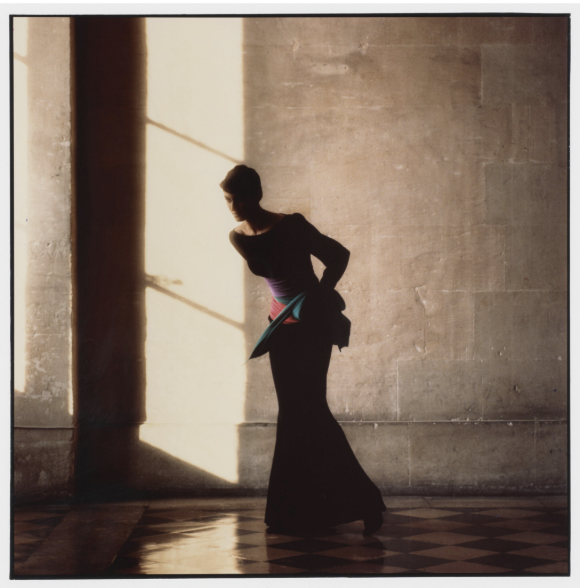
This is where the photograph begins to complicate the idea of the muse. The model is central to the composition, yet her identity remains partially obscured. She is both present and unreachable. This is symbolic of the meaning of a muse: it does not exist. It is, rather, a figment of imagination and creation. Fashion has a particular fondness for the word muse: It's romantic how a woman whose beauty or personality inspires an artist to create, yet the word contains a strange imbalance. The designer’s designs, the photographer's photographs – the muse simply is reduced to the product of this. Laurent’s contribution is an act of creation, whereas hers is often reduced to the condition of being admired.
However, reducing every muse to a passive object can erase the influence these women possessed. A model does not enter an image as neutral material. Her posture, personality, reputation, and relationship with the designer determines the clothes’ meaning and influence.
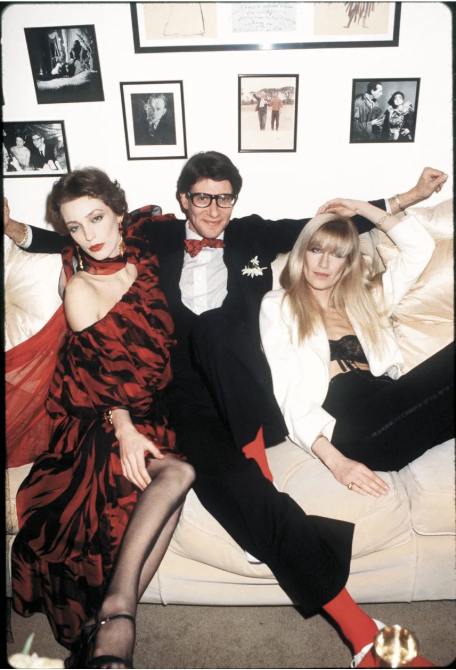
Catherine Deneuve and Betty Catroux are both cited as Laurent’s muses during the 60s and 70s. Catroux’s androgyny, attitude, and distinctive style were not inventions of the designer. The danger of the muse is not that she inspires an artist, but that her influence becomes absorbed into his legacy. The compromise may not happen in the photograph itself, but in how the photograph is remembered.
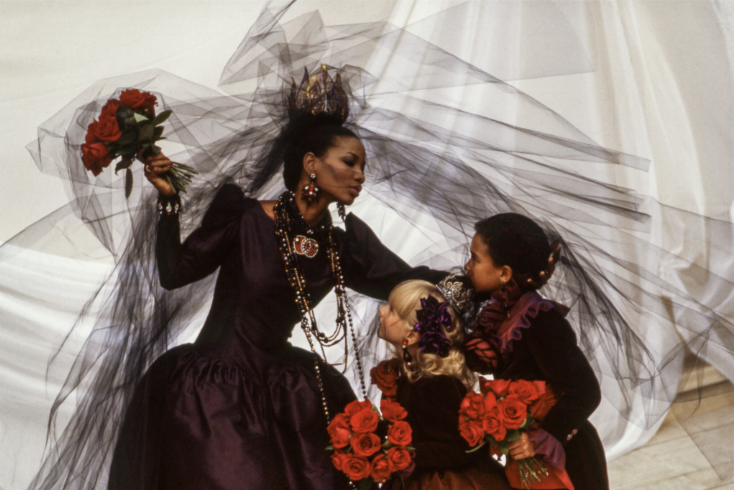
Arthur Elgort’s Wedding dress worn by Mounia Orosemane from the Fall/Winter 1981 haute couture collection depicts a woman dressed in a YSL wedding gown, accompanied by two children. There is no disappearing woman here. Mounia fills the photograph. She wears a plum rather than bridal white, layered jewelry falls across her chest, and an extravagant headpiece rises above her. Behind her, black tulle spreads across the frame like a spider’s web, simultaneously connecting and enclosing the figures beneath it. Where Issermann’s model seems to disappear into the atmosphere around her, Mounia's presence gives the photograph authority. She is not merely wearing the designer’s imagination. She is participating in its creation, dissolving the boundary between muse and collaborator.
She does not perform the expressions we expect from a bride. She does not beam at the viewer. Instead, she looks toward one of the children beside her with an expression that feels serious, almost commanding. The girl and boy look upward toward her, making Mounia appear less like a bride awaiting someone’s attention and more like the center of her own world.
The photograph complicates the idea that fashion simply transforms women into objects. Mounia is styled and placed within someone else’s creative production, yet she doesn't feel interchangeable. Her physical presence is what makes the image work.
Reducing a woman to a muse can turn her into mythology and remove her from authorship. We remember the designer who created the dress and the photographer who created the image; the woman’s contribution is more difficult to name. She may be credited as the subject even when her personality is central to the finished image.
To describe these women only as victims of the male gaze would be to overlook the individuality that such a perspective threatens to erase. The photographs at ICP reveal women doing more than wearing Saint Laurent’s clothes. They pose, perform, confront, exaggerate, and reinterpret them. The garment may start as a designer’s sketch, but its meaning is completed on the body.
I entered Yves Saint Laurent and Photography expecting photographs of clothes. I left thinking about the women inside them. Saint Laurent’s legacy is inseparable from his designs, but this exhibition also makes visible how dependent that legacy was on other people’s bodies, faces, and images. Fashion offers the extraordinary possibility of transformation, of becoming someone beyond ourselves. But when that transformation takes place through another person’s vision, does it become an act of self-expression or self-surrender? The exhibition bears Yves Saint Laurent’s name. But the photographs remind us that a vision cannot come alive on its own. Somewhere between the designer’s imagination, the camera click, and the woman’s pose, fashion becomes art. The question is: whose art do we choose to remember?